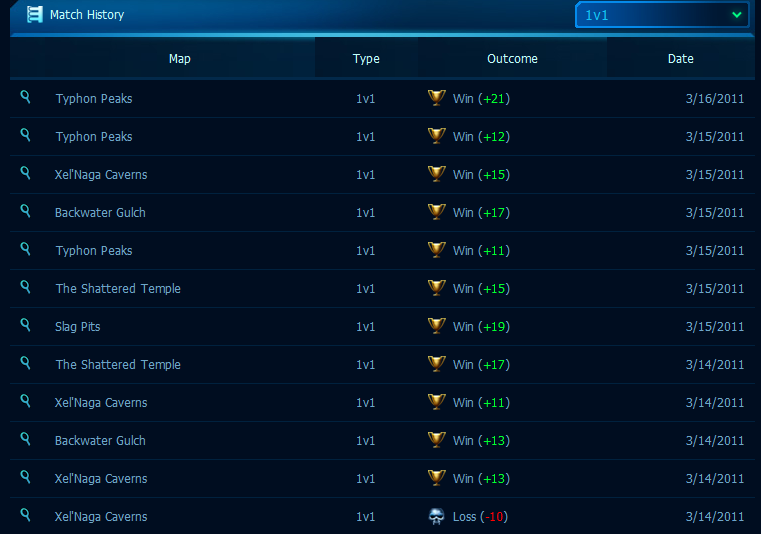
This is false. Do some research. There are some great articles out there about how this is done… which leads me to the next point: [QUOTE=Atavax;266292]the system would have to be much more complex[/quote]
I like your acknowledgement of the fact that people will try to abuse and ‘game’ any system, regardless of its complexity or sophistication (see Addendum).
How does the rest of society deal with those who commit infractions against established systems? Detection and Enforcement. Splash Damage still has the discretion to wipe account statistics or ban user’s accounts who are suspected of foul play.
Developers Are Responsible For All Aspects of the Gamer’s Interaction with Their Product - Including the Gamer’s Interaction with the Gaming Community:
You discount the fact that the game developers have a real stake in what type of communities evolve in concert with their game’s lifespan. When the power to set matchmaking conditions, etc. resides with the server administrators then the developers can lose control over the type of experience that the player has.
Sometimes developers are willing to surrender that control to server administrators. Sometimes developers like to hand over the control to the community at large. Other times, developers place a premium on certain elements of the user experience and do their best to ensure that the player’s experience is strictly consistent with respect to those elements.
A significant reason that a default matchmaking system was implemented in Starcraft 2, is that Blizzard wanted to ensure a consistent experience for players when finding games. Their former Battle.Net system of searching for games was ‘broken’, as they put it. Did interesting communities arise under the old Battle.Net system? Absolutely. However, the system was less user-friendly and players had to be more savy when finding games. In the case of custom games, their former system was a disaster.
There are real problems with the current Starcraft 2 custom game implementation, but it is, nonetheless, much easier to find, join, start, and play custom games in Starcraft 2 than it was on the old Battle.Net.
One notorious original Starcraft and Warcraft 3 community arose with the development of “Aeon of Strife” / “Defense of the Ancients” (DOTA). This community has often been described as toxic. The DOTA game mode, itself, is incredibly fun and engaging, but the learning curve is steep and most games had the “No noobs” + “Only Pros” disclaimer, to the point where you couldn’t find DOTA games if you weren’t an established player. When a new player is finally able to find a game, they will frequently get booted because of their poor performance in-game. The DOTA community was an instance when the autonomy granted to server administrators and communities made the game inaccessible to players who weren’t a member of that exclusive club.
“Aren’t gamers and gamer communities entitled to playing the game how they want and to the exclusion of other players?” I think that in niche instances (or dedicated creative communities) then they absolutely should have that level of autonomy. If the community is toxic, then so be it.
However, as I’ve already stated players don’t necessarily enter a contract with the game’s community when they hand over $60 in purchase of a new video game. The gamer is making a purchase in good faith, and they are buying an entertainment product from the publisher/developer responsible for the title. The game is selling the promise of entertainment complete with the promises of features (as communicated through marketing promotions and crowdsourced reviews).
The feature we are discussing is the promise of multiplayer gameplay. As the developer, you have a responsibility to deliver upon the promise that you made and that the would-be player accepted in good faith. Other individuals or groups of individuals aren’t entitled to depriving the would-be player of that experience. The only way that they would gain the power to do so is if they were granted such power (by the developer) or if there were omissions in the game design that enabled them to have such power over the would-be player. Otherwise, it is the developer’s responsibility to make good on their promise.
It is easier to let communities manage themselves, because their demands and enthusiasm are tireless and they know exactly what they want. The manpower to appease a community is utterly insane. The only thing that could sustain it would be the community itself. However, the community didn’t sell me the product. The developer did. In which case, the developer is the middle man in all of my interactions with the community. They determine and guide the nature of all of our interactions. When more power is handed over to the community, remarkable things can happen, but not all of those outcomes are to the benefit of the would-be player, nor are they necessarily consistent with the promises made by the developer to the player.
[QUOTE=Atavax;266333]Why don’t justice systems the world over just develop algorithms to determine what is and isn’t enough proof to be convicted of a crime?[/QUOTE]We do have such algorithms. We codify it, and we call it Law, Legal Practice, the Legislative System, and the Justice System: What is a crime and what isn’t. What is admissible as evidence and what isn’t. The algorithm is roughly: impartial discretion and judgement applied to precedent as weighed against the body of evidence through due process.
Peer review relies on the computational power of the human mind to weigh the relative merits and come up with a determination of who is better. Peer review is computationally expensive and time consuming. The administration of peer review needs to be monitored in order to prevent collusion or the abuse of power.
Algorithms provide useful, time-saving methods to make determinations. For the sake of argument, the aggregate decision-making ability of peer review could be coded into the parameters of an algorithm and used to make predictions or to evaluate future instances in a manner consistent with the original peer review system. Obviously, such an algorithm wouldn’t have the breadth of scope that peer review enables, but the algorithm would be much more efficient when applied to a large volume of instances that only ever varied within a defined, predictable range.
What constitutes “the best” is entirely subjective, depending on what virtues you consider worthy of acknowledgement. That is why people can’t come to a consensus about who is or isn’t the best at a given sport.
TL : DR
ELO is NOT about policing players who are disruptive on a server (although there may be implications of varying ELO ranks upon the nature of the players themselves). ELO is about matchmaking (and ranking to a lesser extent). ELO is not necessarily about who is “the best”. Tournaments are the way that we gauge who is the best, and even then “the better team doesn’t always win”. Tournament results are, ultimately, only accurate and relevant for that given moment in time under those specific tournament conditions.
Addendum:
Abusing Systems in Videogames and Sports:
In videogames, Griefing is much easier to do when ELO systems aren’t in place. When an ELO system is responsible for matchmaking, you would need to lose many games in order to be eligible to play lesser players. As tokamak noted, wins against lesser players will cause your rating to rise and you will start to be matched up against more challenging and more evenly matched opponents.
ELO matchmaking systems seem to effectively curb Smurfing. The only way that dummy accounts and smurfing are still relevant are when set matches are administered outside of matchmaking. Otherwise, the ELO matchmaking algorithm wouldn’t match a significantly lesser-ranked player with a higher-ranked one.
Halo 3’s ELO system was famously exploited by teams of players to help one (or more) of the team’s members reach the Skill cap of 50. Halo 3’s ELO matmaking algorithm created a team ranking by weighting each member’s ranking in concert. The team ranking was a blend of the individual player rankings. In this manner, you could game the system by having a number of highly ranked players on a team with an extremely low rank player. The low rank player would significantly shift the team’s overall rating down. Since the low ranked player was playing on a dummy account (a new account) but was actually a highly skilled player, the team was not only likely to be matched against lesser opponents, but the performance bonus awarded would be even greater than normal when victory was achieved against other players of high rank.
A Korean Starcraft league scandal arose when it was revealed that matches were fixed, by featuring a higher proportion of terran-favoured maps, to the benefit of an otherwise unaware fan-favourite terran player.
There are countless examples of match fixing in sport. It is a testament to human intelligence and enterprise that people will find a way to game any system. Does that mean that we should throw our hands up in the air and declare that since no system is perfect that all systems should be abolished? Of course not. We do the best we can. We iterate and improve, and we try to apply and regulate our flawed systems with wisdom and justice.
“Men must be governed. Often, not always wisely, I will grant you, but governed nonetheless.”