
Various LIGHT compile times.


(Deiscorides) #1

I have a somewhat large map I am making for True Combat. I am wondering, given the information below and the experience many of you on this forum have, what would be a general estimate of the time it would take to compile the LIGHT phase? Specifically, the first Radiosity bounce at the “IlluminateRawLightmap” part . I have the bounce set at 10, which of course it will not use all of them and will most likely stop at half that. Here are some current information about the map, the LIGHT switches I am using for my current compile and general stats of my computer:

11339 total world brushes
10377 detail brushes

Lightgrid bounds: { -3200.000000 -2176.000000 -7552.000000 } { 2432.000000 9088.000000 1408.000000 }

Grid size: 94 94 128

My LIGHT compile switches:

-light
-bounce 10
-custinfoparms
-filter
-patchshadows
-smooth
-super 2
-v
-fs_game truecombat

Computer stats:

AMD Athlon 1.72GHz
512RAM
2gig Page File

As a note the first part of the compile, just before the first Radiosity bounce began the “IlluminateRawLightmap” took 15,385 seconds(just over 4 hours). I started this compile, April 15, 2004, 12:12:56 AM EST.

(ydnar) #2

Remove these switches:

-filter
-smooth
-super 2

and add these switches:

-fast
-samples 2

The reason is, -fast lighting is OK for final compiles, -smooth is the same as -samples 2, -super 2 requires 4x the memory and compile time with approximately the same benefit as -samples 2, and -filter disables -smooth or -samples 2 anyway, rendering it ineffective.

Also make sure you’re supplying a correct -fs_basepath argument.

y


(Deiscorides) #3

The use of -filter and -smooth was indeed a mistake of the checkboxes. I did not realize I had actually done that until this morning after starting the compile at night. So, I left it.

About the -super 2 memory usage. Is that only the memory required while compiling or is that memory required to actually play the map in the game? If it the memory required while compiling then I have no problem with it.

This is the 403rd compile of this map. This is my first “final” compile test. The others were all just quick compiles for testing. I beleive the -fs_basepath argument is correct, as I have had not trouble in that area. The map is far from being finished, but I wanted a measure of how long it may take for a full compile. I’m thinking this will take several days to compile, unless the bounces after the first one go much faster, as I have seen them do in the fast test compiles. A fast compile takes only 45 minutes.

The lighting in this map needs to be as acurate as it can possibly be due to its design. That is why I wish to not use the -fast switch.


(ydnar) #4

If you’ve been testing it with -fast, then keep using -fast. If you don’t use it you’ll be subject to very long radiosity compiles and brighter lighting.

The -fast switch is OK if you know what effect it has on your map.

I don’t advocate using -super 2 anymore because it just wastes memory/CPU when -samples N does the job equally if not better, in 1/3 the time.

y


(Deiscorides) #5

Hmmm…that’s really odd looking. After seeing the pics you just posted I went and looked at all the screenshots I have of mine. From what I remembered and from the screenshots I have never seen such “pixelated” and blocky shadows like that in my map after any compile. Though, in a lot of maps I have seen a great deal of blockiness and wondered what was causing it. Those ‘other’ maps I am refering to are older maps and thus used an older version of Q3map2.

I’ve been using -fast pretty much for light placement and this full compile will be for light inspection which will bring about 6 or 7 pages of notes I’m sure. lol

But again, please tell me, is the memory/CPU usage of -super 2, you are refering, to just in the compile stages or is it in the game while playing. Knowing this difference could help me greatly.


(ydnar) #6

The -super switch only affects compile time memory usage.

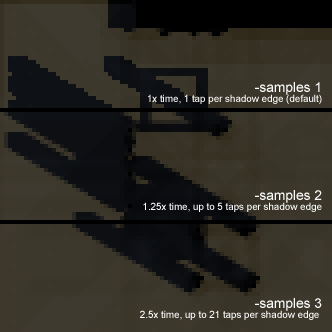
To compare:

-super 2 : 4x oversampling per luxel, regardless of where it falls
-samples 2 : 1x sampling except on shadow edges, where up to 4x more oversampling occurs
-samples 3 : same as -samples 2, except the oversamples are further divided into 4 pieces if required for 1 + 4 + 16 = 21x max oversampling

Using -super 2 will take 4x the time as -super 1 (default).

Using -samples 2 will take on average 1.3x as long as default, for comparable or better quality to -super 2.

Now if you insist on using -super 2, I can’t stop you. It’s your time.

y


(Deiscorides) #7

Thank you for the clarification on the memory usage. For memory and time I am not at all concerned. I will not run out of either. My net connection is 28.8kbs and thus have learned great patience with all things. lol

Depending upon the results of this compile will determine if I will use this particular setup for the final compile or not.


(Deiscorides) #8

Well, the first radiosity bounce took 29 hours. I went a head and stopped it after only one as I thought it would give me a good example. Funny thing, the sun’s lights are the only thing it made brighter. The normal lights and my ambient light rods all stayed the same brightness.

I could not see any other difference other than a brighter sun or moon in this case. lol As a result I’ll be using the -fast switch from now on.